|
Rail
For 5" gauge there are generally two rail profiles
available.

Left 16mm or 5/8" fell rail, available in
aluminium. Right 21mm available in steel or aluminium
For 7 1/4" gauge railways there are more choices with
several custom profiles in alunminium on the market or custom produced profiles
by clubs or individuals. The guidence for 7 1/4" gauge is still the same
although if you are running engines that weigh in at over a ton, you are more
likely to run on steel track.
The cost of steel and aluminium are very
close so usually it is other factors that influence the choice.
STEEL - Profiled rail - 21mm from
MRSC
Advantages
- Very strong, needs less support (less
sleepers if required)
- Can be welded for rigidity or for example
constructing crossovers
- Lower expansion rate. Half that of
Aluminium
- Good impact resistance - hard wearing -
especially good for areas such as point blades and frogs.
Disadvantages
- Rusts - with constant running isn't really a
problem
- Hard to bend. Good for staying in shape once
bent but is hard bending by hand. Can be bought from Miniature Railway Supply
Company pre curved but for flexibility I would recommend one of our rail
benders
- Heavy - not very good for portable track as
you will only be able to lift 3 panels at a time.
- Hard - may save rail from excessive wear but this may be
taken out on your rolling stock.
ALUMINIUM - 16mm and 21mm
Advantages
- Easy to bend - Good for laying, bad for un
supported track
- Light weight - good for portable track - I
can easily pick up 15m
- Doesn't rust
- Soft material - doesn't wear the wheels -
very important if you have a £8k steam engine
Disadvantages
- Soft material - With sharp corners sign of
ware show quite quickly, also derailments can damage track.
- Point blades and frogs made from aluminum can
show signs of wear very quickly.
- High expansion rate. Hot sunny days can see
track snaking as it expands. - Must allow for expansion at joints.
|

|
Left - Aluminium rail - this piece was nearly 8 years old in use
on our bottom curve which is an 11 foot radius. I would consider that we are
reasonably heavy users so I don't think this wear is unacceptable.
We could have re gauged the track and carried on using the rail but decided
to replace it with steel.
The rail won't we wasted as it will be straightened, turned and used in our
new siding. |
Suppliers
PNP Railways - Paul Norman Plastics - Aluminium rail + Plastic sleepers,
chairs etc. 16mm and 21mm aluminium alloy
Miniature Railway Supply
Company (MRSC)- steel
and aluminium alloy, flat bottom profile 21mm high + 16mm aluminium alloy
Cromar White - 16mm high Alloy
Maxitrak - 16mm high profile aluminium alloy
Bar Track
| While many clubs use bar track there can be
problems. The running edge of the bar needs to be rounded or else it can easily
cause excessive damage to the wheels. In the garden environment with tighter
corners the sharp edge can destroy wheels in quite a short time.
The wheels on the right were off a Trojan which had been run on
a garden track constructed from steel bar. It had tight radius corners which
caused excessive wear on the wheels. These wheels have had less than 6 months of
occasional running.
For club running with large sweeping curves, the chances of
marking the wheel flange is greatly reduced. |
 |
Sleepers

1) Timber roof battern - 225mm
long - 32mm x 25mm - Timber is tanalised but we also immersed them in
creosote(or new alternative) for at least a fortnight. Rail fixed with 3/4" x 8
pan head screws with M4 penny washers.
2) Aluminium - Jubilee rail -
copy of the narrow gauge sleeper for temporary track ie used on peat bog
systems. Advantage of not rotting but major diadvantage is that the track sits
on top of the ballast and the track is prone to movement. Only for 16mm
rail.
3) Timber battern as per number 1
but with plastic chairs as supplied by PNP Railways.
4) PNP Railways plastic sleeper.
Offers pre set gauge and possibility of gauge widening + rot
resistant.
5) NOT SHOWN - PNP railways
produce a clip together system in 5" and 7 1/4" gauge. Panels can be assembled
in a matter of minutes. A major plus given a panel can take up to an hour to
screw together.
5" Gauge Sleeper
Spacing
|
 |
 |
 |
|
|
6 sleepers per metre
Temporary use or hidden sidings/sheds |
9 sleepers per metre.
This is what we found looked good. |
12 sleepers per metre
Just too much although near standard gauge track standards |
|
 |
Hardwood vs Softwood
Many people have written on the subject of sleepers and quite a
few have written off softwood as a short term investment. The picture on the
left is of sleepers which have been down for 8 years. There is no sign of rot
and still have many years of life yet.
In comparison we have seen hardwood supplied with a point kit
degrade quite badly to the point where they needed to be replace. It didn't help
that they came with live woodworm in.
Recycled Plastic
Recycled plastic sleepers have many advantages but one major
disavantage. In the sun they can curl. Do not use on points as the distortion in
the longer sleepers can affect the operation of the
point. |
Thermal Expansion
Why should this bother me?
Below is a table showing the thermal expansion of three materials.
Concrete has been inlcuded as a comparision.
|
Product |
Linear Temperature Expansion
Coefficient |
|
(m/m. oC x 10-6) |
(in/in.oF x
10-6) |
|
Aluminium |
22.2 |
12.3 |
|
Concrete |
14.5 |
8.0 |
|
Steel |
13.0 |
7.3 |
Column two shows the expansion rate per degree in temperature
rise. If for example we say that it could easily get to -10oC in the
winter and easily get to 50oC in the summer (if the track sits in the
summer sun all day) we will get a temperature range of 60oC.
Therefore a
So for a track in the sun you will need to leave movement for
3.3mm for aluminium and 1.95mm for steel. Yes movement.
-
Fishplates should not be bolted tight - use nylocs or double
nuts.
-
Regularly grease or oil. This also helps reduce electrolytic
action that can lock up fishplates and stop the rail moving.
-
Over drill the holes in the rail - use 5 or 6mm drill bit for 4mm
bolts.
-
If laying rail on a very hot day the rails should butt each other.
At 20oC the rails should be mid way through their
movement.
Don't worry too much. If you get it wrong the rail will find its
own way to expand. On corners it will push out and on long straights it can even
lift the track into the air. Over a period of time you will soon learn where you
need to allow for more expansion.

Above - This is the inside of a curve and taken
at 3pm on a sunny June day. The gap between the ballast has been left as the
rail pushes out the curve as we had not allowed for expansion in the fish
plates.
Restaining the sleepers can allow the rail to slide on the
sleepers and the expansion to be taken up in the gaps left in the fish plates.
It is not recommended to try and totally restain the rail as you will find at
some place the rail will find a way to move to accommodate the expansion.
On the full sized railways welded sections are often laid
stretched so the any expansion can be taken up in the spring of the steel. With
most miniature rail supplied in 2.5m or 3m legnths I think you would be hard
pushed to lay rail pre tensioned.
Points
Don't believe there is anything such as a standard
point.

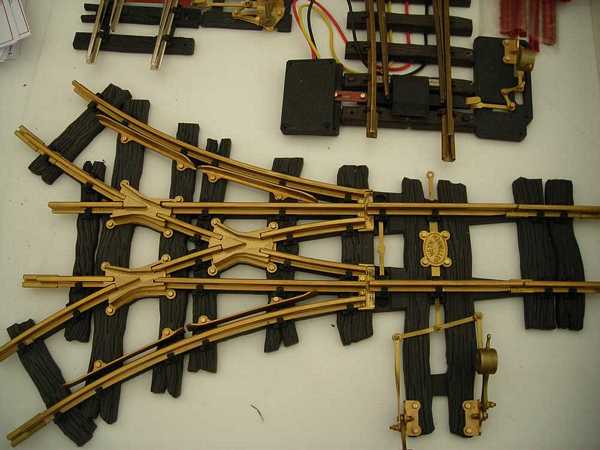
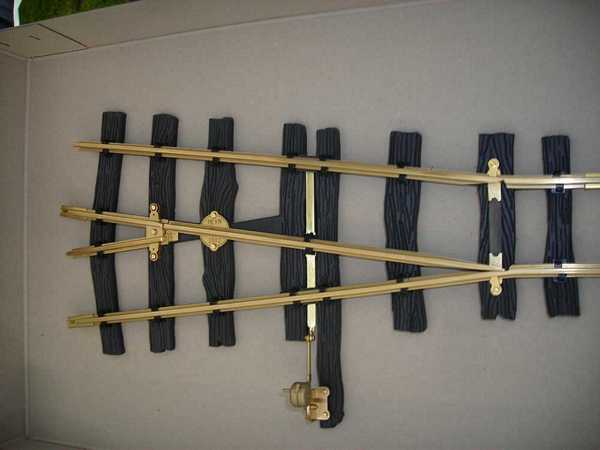
The picture above is of one of our standard 5"
gauge points. Over a peroid of years I have noticed that there is no such thing
as a "standard pair of points".
Why are they so expensive? The simple answer is that
they are complex and complicated. Our points are made up from 168 parts and
takes the best part of a day to assemble.
From experience we found that cast aluminium frogs
fail quite quickly (medium to heavy use) as the aluminium is not strong enough
to cope with the impact of the wheels. To combat this we use a laser cut steel
frog. Also on the market are cast iron frogs which also cope better. That said
and done, the aluminium frogs are not expensive and can easily be
replaced.
Notes
-
The check rails are to protect the frog and stop the
wheels straying up the wrong side. Make sure they are located correctly and not
just bolted on to the adjacent sleepers.
-
The curve on the turn out has more than one
radius
-
For 5" gauge check rails need 6mm clearence. Point
blades also need to clear at least this
-
For your first point - buy ready made. Kits may sound
cheap but without reference to how it should go you will easily lose a couple of
days constantly tweaking it to get it right.
Next Stage- Curves and Gradients
|